
Grid
One control, four ways to look at the same records, and a renderer that does the same amount of work for a thousand rows as for a million.
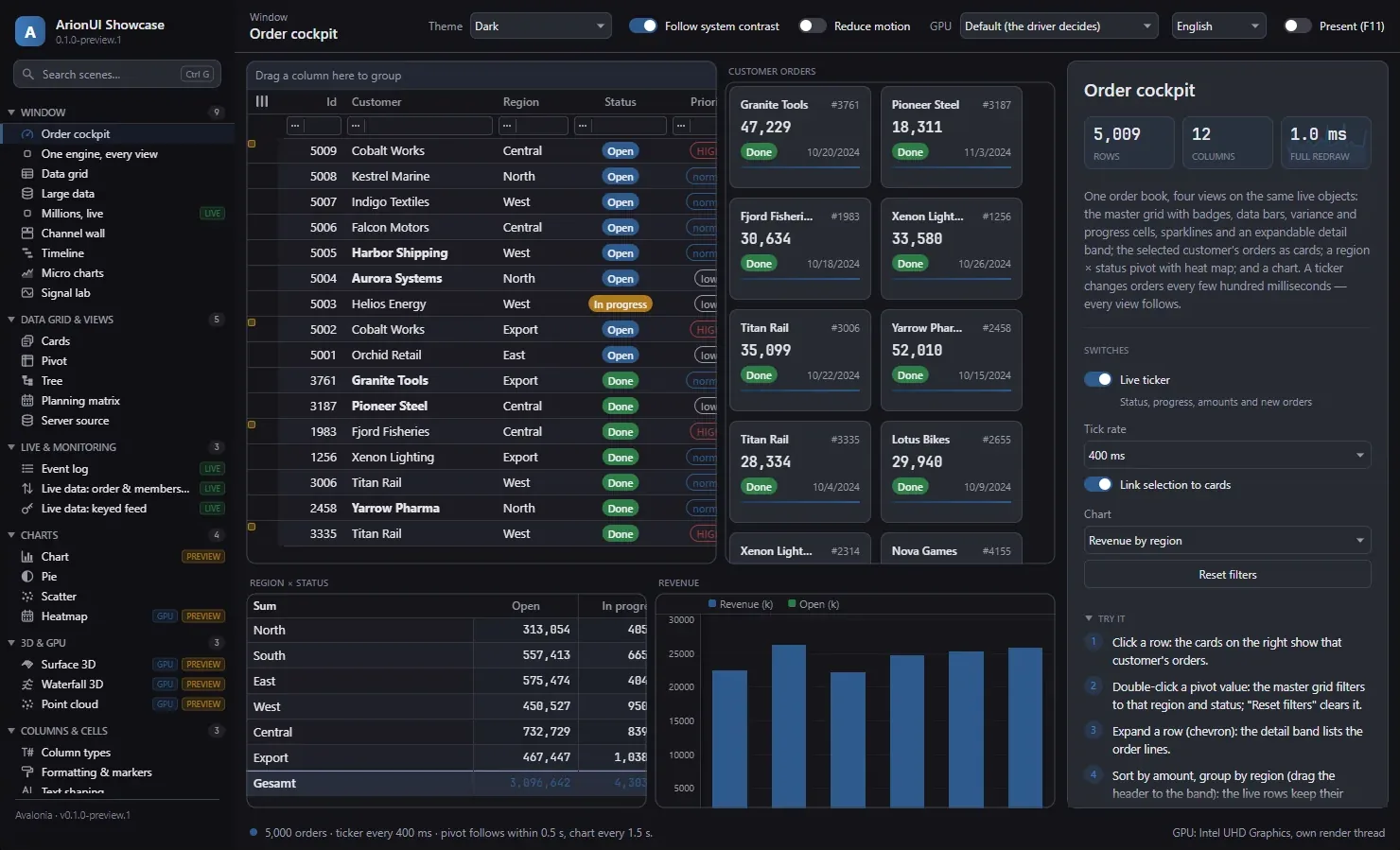
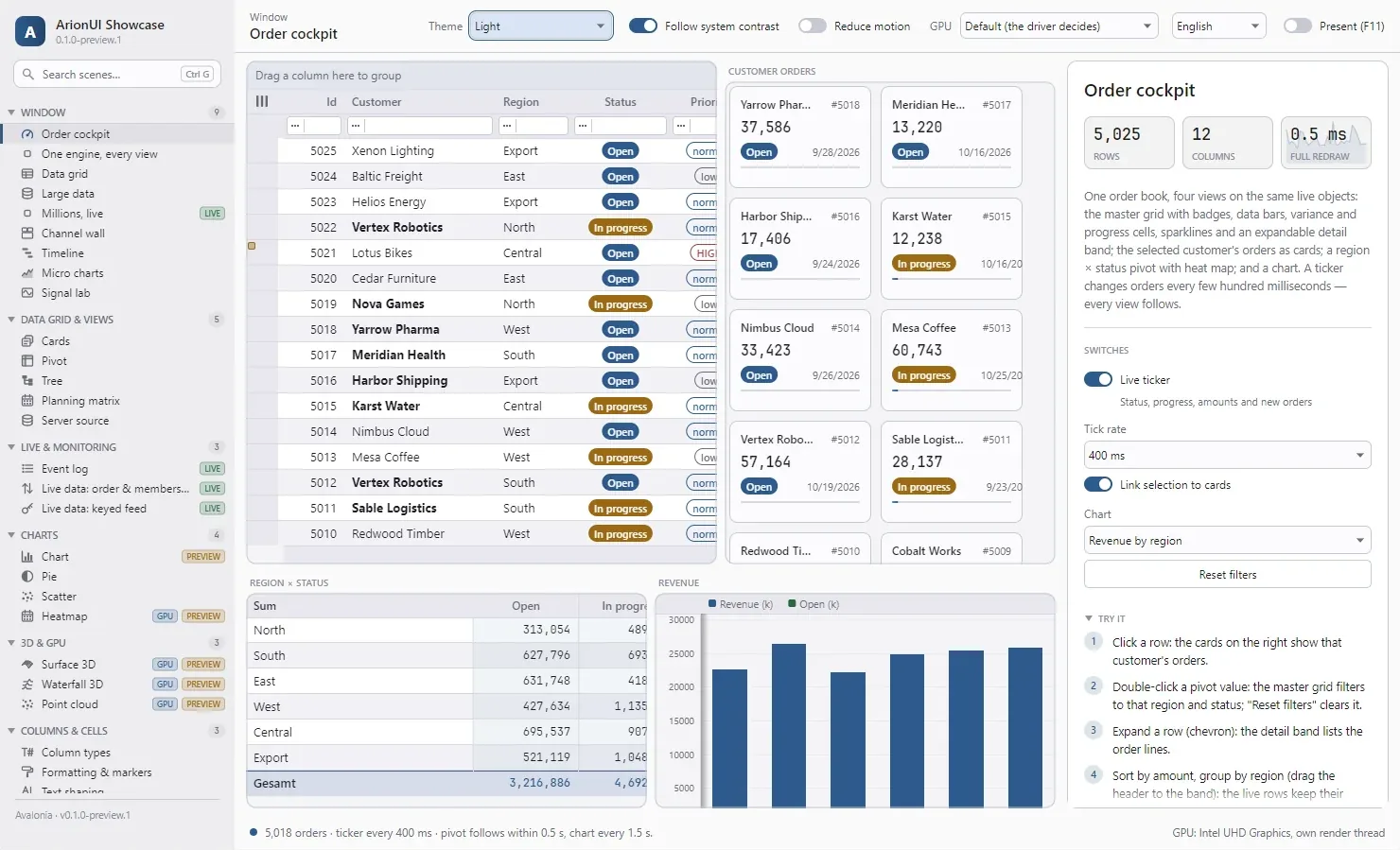
What the table does
- Sort on header click, multi-sort with Shift, and a filter row under the header, plus value filters in a list.
- In-place editing with a self-drawn editor, typed editors and input masks; undo and redo of every edit.
- Search with match highlighting, a column chooser, column resize, auto-size and reorder.
- Card board and tree views of the same data, and master-detail rows.
- Keyboard navigation throughout, copy to the clipboard, and screen-reader support through UI Automation on all three hosts.
- Shaped text with font fallback, so CJK, Arabic, Indic scripts and emoji render correctly, and bidirectional text inside a cell.
- Dark and light themes built in, freely configurable.
Pro modules
Separate NuGet packages on top of the open engine — free during the preview, also commercially (see Pricing).
- Grouping from the column header, with group rows, aggregates and the group band —
ArionUI.Grouping - Pivot view with both axes collapsible —
ArionUI.Pivot - Conditional formatting with a rule manager —
ArionUI.Formatting - Charts, including 3D on the GPU —
ArionUI.Charts,ArionUI.Charts3D(see Chart) - Timeline view and planning matrix —
ArionUI.Timeline,ArionUI.Planning - Layout persistence across sessions —
ArionUI.Layout - Export to CSV, XLSX and PDF —
ArionUI.Export
The layers hold
Each layer names only what sits below it, and that boundary is enforced by tests rather than merely intended.
- ArionUI.Core
- The engine: virtualization, layout solver, scroll physics, interaction and the data sources. No UI framework — no Avalonia, WPF or Skia type appears anywhere in it.
- ArionUI.Presentation
- Views, column definitions, the cell composition model and theming. Framework-neutral.
- ArionUI.Grid
- The grid itself — panes, input wiring, the consumer API
ArionGridApi, accessibility. It draws only throughIRenderSurface. - ArionUI.Gpu and ArionUI.Rendering.Skia
- OpenGL ES 3.0 through a host-supplied loader, and the single Skia renderer shared by every host.
- ArionUI.Rendering.Avalonia, .Wpf and .WinForms
- Thin hosts: input mapping, a surface and a frame clock. Because the renderer is shared, all three draw the same frame.
GPU by default, CPU when it has to be
The default path renders on the GPU. Where none is available the engine falls back on its own to a CPU path that shifts the existing bitmap and repaints only the strip newly scrolled into view, and it logs that it did. Neither path scales with how many records you loaded.
What it does not do yet
Stated here rather than discovered later.
- It is an early preview: the API still moves, and breaking changes between preview versions are expected.
- No multi-touch gestures such as pinch; one finger works like a mouse.
- No mirrored right-to-left layout of the grid itself (bidirectional text inside a cell works).
- No IME pre-edit display.
- The WinForms host builds from source but is not yet a NuGet package.
What is planned, and what is not: Roadmap. Whole windows around the grid — boards, style sheets, drawn controls — are on Board & Styling.
Licence and source
The engine is open source under the Apache License 2.0, patent grant included; the source and the issues are on GitHub. The Pro modules are NuGet packages without source, free during the preview.